
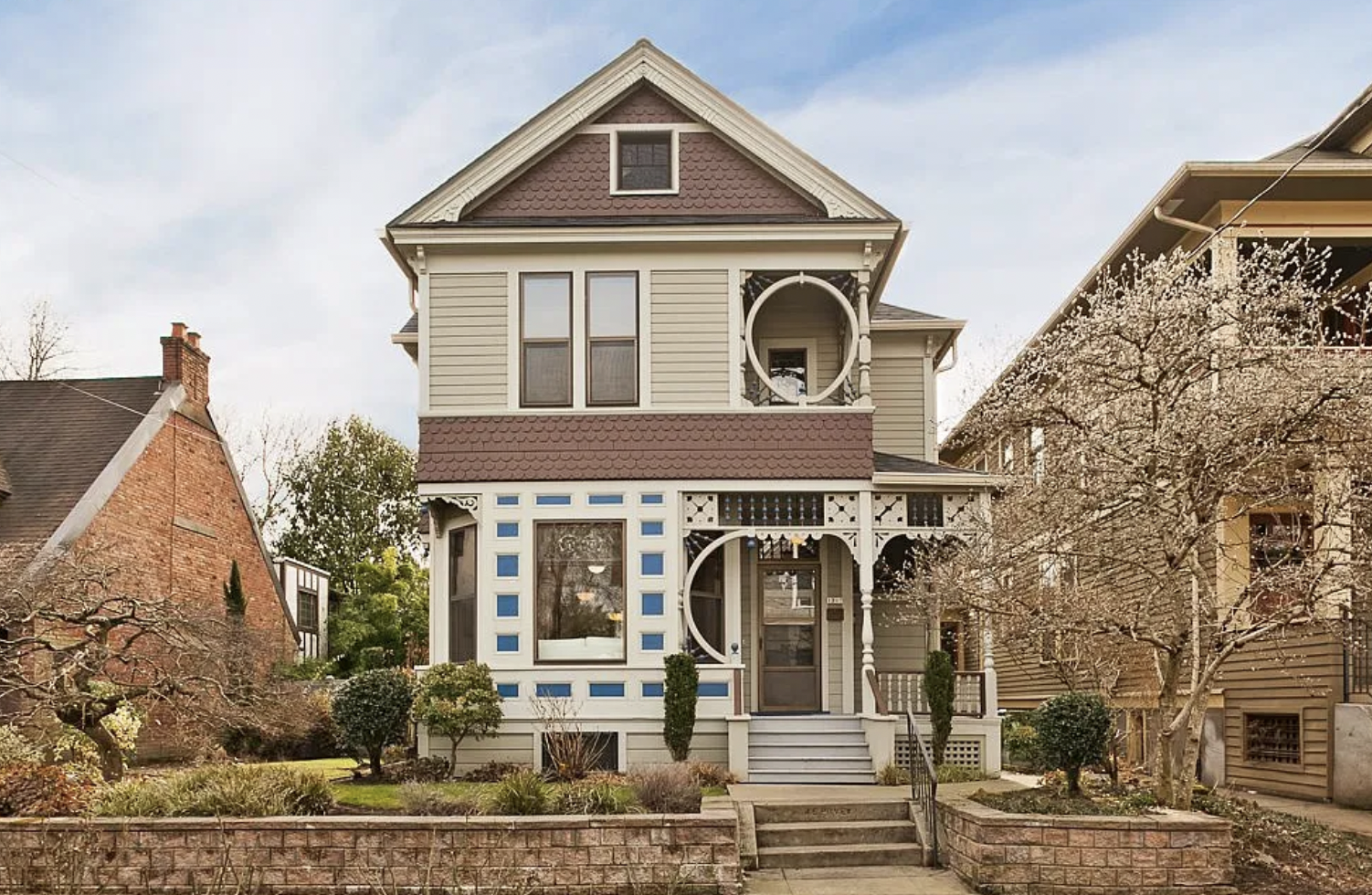
Irvington is a Northeast Portland neighborhood platted in 1887 on the Irving family’s land claim and built mostly between 1891 and 1948. Its Queen Anne, Craftsman, Colonial Revival and Prairie School houses form the Irvington Historic District, listed on the National Register in 2010 with about 2,800 resources.
A riverboat captain’s claim, the deeds that shaped it, and ten addresses worth knowing.
Irvington was sold with rules. When the first big tract of lots opened in 1891, every deed told the buyer how far back to set the house, how much it had to cost, and what could never happen on the land. Those rules kept stores on Broadway and houses on the side streets, and more than a century later the result is a neighborhood of about 2,800 buildings that the Irvington Community Association calls the largest historic district in Oregon. This is a guide to those houses, the nine Irvington buildings listed on the National Register in their own right, and the neighborhood school.
Irvington is one of nineteen neighborhoods on Just Portland’s guide to Portland neighborhoods, and it shares a lot with the two neighborhoods covered so far, Laurelhurst and Eastmoreland: planned streets, deed rules and a National Register listing. Irvington came first.
How did Irvington begin?
Captain William Irving, a riverboat captain, and his wife Elizabeth took up a donation land claim here in 1851 and built a home near the river. William died in 1872. Ten years later Elizabeth came back to Portland to subdivide the land, according to the Oregon Encyclopedia.
In 1887 she sold half her interest to David P. Thompson, John Brazee and Ellis Hughes, and the Irvington plat was recorded that October: 129 blocks running from Fremont Street south to Tillamook. The Irvington Investment Company, led by Hughes, managed the sales through the 1890s. Later plats added East Irvington, West Irvington and Edgemont.
The financial panic of 1893 all but stopped lot sales for a time. Streetcars brought buyers back: by 1899 a line ran down Broadway and up 22nd Avenue to Tillamook, and by 1912 there were lines on Broadway, 15th, 22nd and 24th.
What rules shaped Irvington?
In July 1891 a larger tract opened east of NE 14th Avenue and north to Thompson Street, and its deeds carried building restrictions. The Irvington Community Association’s history lists them: no making or selling liquor, no places of business, no building within 25 feet of the street, no house costing less than $2,500, and no Chinese residents. The Oregon Encyclopedia counts them among the earliest known covenants in the Portland area.
The first covenants were written to expire in 1916. Their lasting effect was on the map. With business barred inside the neighborhood, Broadway became its commercial edge, and the side streets stayed residential.
Irvington was sold with rules.
What kinds of houses are in Irvington?
The National Register lists four styles for the district: Queen Anne, Colonial Revival, Craftsman and Prairie School. The oldest houses, from the 1890s, are Queen Anne, with turrets, spindlework and wraparound porches. After 1905 the architects of the next generation, Ellis F. Lawrence and Joseph Jacobberger among them, brought Arts and Crafts, Tudor and eclectic designs.
Lawrence lived here himself. In 1906 he built a double house on NE 21st Avenue for himself, his mother and his sister, a block from the Irvington Club, and he designed several of the neighborhood’s best-known buildings over the next five years.
Readers who know Los Angeles will recognize the range. Irvington’s Queen Annes are cousins of the Victorian houses of West Adams, and its Arts and Crafts houses share a vocabulary with Swiss Craftsman Row in Adams Normandie and the historic homes of Los Feliz.
Which Irvington buildings stand out?
Nine of these ten are listed on the National Register on their own, in addition to the district. The tenth is the neighborhood school.
John E. G. Povey House, 1312 NE Tillamook St
Built in 1891 for the art glass maker John E. G. Povey, this Queen Anne and Eastlake house is among the first in the West Irvington subdivision. Peter Hobkirk of Hobkirk and McKenzie built it. It was listed on the National Register in 1998.
Roome-Stearns House, 2146 NE 12th Ave
The Portland Cottage Building Association built this Queen Anne cottage in 1893. It was listed on the National Register in 1992 and is also a Portland Historic Landmark.
George Earle Chamberlain House, 1927 NE Tillamook St
George Earle Chamberlain, governor of Oregon and later a United States senator, bought this early 1890s house in 1904 and lived here until his death in 1928. It was listed on the National Register in 1991.
Gustav Freiwald House, 1810 NE 15th Ave
A Queen Anne house with a corner turret, built in 1906 for Gustav Freiwald, a real estate man and one-time owner of the Star Brewery in Vancouver, Washington. It was listed on the National Register in 1993 and is a Portland Historic Landmark.
Henry B. Dickson House, 2123 NE 21st Ave
Ellis F. Lawrence designed this two-and-a-half-story eclectic house in 1909 for Henry B. Dickson, a bank teller. It mixes Craftsman and Colonial Revival, and it was listed on the National Register in 1997 as part of a group recognizing Lawrence’s work.
James C. and Mary A. Costello House, 2043 NE Tillamook St
James C. Costello was an Irvington developer, and in 1910 Joseph Jacobberger designed his family’s own house: Arts and Crafts, in rough-cut stone and stucco under cross gables. It was listed on the National Register in 2001 and is a Portland Historic Landmark.
Henry B. Miller House, 2439 NE 21st Ave
Ellis F. Lawrence designed this Tudor Revival house in 1911. It was listed on the National Register in 1989.
Barnhart-Wright House, 1828 NE Knott St
The contractor Frederic E. Bowman built this English Arts and Crafts house, with touches of the Prairie School, in 1913 and 1914. Its early owners were Harvey P. Barnhart and, from 1917, Charles F. Wright of Ballou and Wright. It was listed on the National Register in 1997.
Irvington Tennis Club, 2131 NE Thompson St
The Irvington Club was founded in 1898 with 25 members, "to cultivate neighborliness, good citizenship, morality and athletics," and sponsored the first Oregon State Tennis Tournament in 1899. Neighbors raised $10,000 in 1905 to buy the block it stands on, and Ellis F. Lawrence designed the clubhouse in 1911. It was listed on the National Register in 1990.
Irvington Elementary School, 1320 NE Brazee St
The neighborhood school, designed by George Howell Jones and built in 1932, is a contributing building in the district, with murals by Ed Quigley in the lobby.
The historic district runs east to NE 27th Avenue, a block past the neighborhood association’s line at NE 26th, so check both maps for an address near the edge.
What does the Irvington Historic District cover?
The Irvington Historic District was listed on the National Register of Historic Places on October 22, 2010. It runs from the middle of NE Fremont Street south to the middle of NE Broadway, and from the middle of NE 7th Avenue east to NE 27th Avenue, with a short strip of NE 28th between Tillamook and Hancock. Its period of significance runs from 1891 to 1948, the year buses replaced the streetcars.
The district counts about 2,800 resources, and 2,394 of them, more than 85 percent, are contributing. Since November 2010, the City of Portland has required Historic Resource Review for new construction and most exterior changes in the district. Painting and roof repairs are generally exempt.
About 2,800 buildings, and more than 85 percent contributing.
What else is Irvington known for?
Trees. The Irvington Community Association counts about a tenth of Portland’s Heritage Trees in the neighborhood, and the best known are nine Caucasian wingnuts at NE 15th Avenue and Knott Street, around Augustana Lutheran Church, designated together in 1996.
And the Irvington Home Tour, held on the third Sunday in May. The first tour was in 1967, and it has been an annual event since 1983, raising money for the neighborhood’s schools and services.
How does Irvington compare with historic neighborhoods in California?
The review process will feel familiar to anyone who owns in a Los Angeles historic preservation overlay zone like the one in Los Feliz: exterior changes go through the city, and the streetscape is what is being protected. Coastline 840 has a fuller look at how California protects historic architectural homes, a useful side-by-side with Portland’s rules.
Ellis F. Lawrence and Joseph Jacobberger are Portland’s own, the counterparts of the Southern California names in Debbie Pisaro’s architects guide, and both will get pages of their own on Just Portland.
Debbie Pisaro writes Just Portland, on the city’s neighborhoods, its architecture and its houses. One note a week.
Join the listHow big is the Irvington Historic District?
The Irvington Historic District counts about 2,800 resources, and 2,394 of them, more than 85 percent, are contributing. The Irvington Community Association calls it the largest historic district in Oregon. It runs from NE Fremont Street south to NE Broadway and from NE 7th Avenue east to NE 27th Avenue.
When was Irvington listed on the National Register?
The Irvington Historic District was listed on the National Register of Historic Places on October 22, 2010. Its period of significance runs from 1891, when the first lots opened for sale, to 1948, when buses replaced the neighborhood’s streetcars.
Who was Irvington named for?
Irvington is named for Captain William Irving, a riverboat captain, and his wife Elizabeth, who took up a donation land claim on the land in 1851. After William’s death, Elizabeth subdivided the claim, and the Irvington plat was recorded in October 1887.
What did the original Irvington deed restrictions say?
The deeds for lots sold from 1891 banned making or selling liquor and running a business, required houses to sit at least 25 feet back from the street and cost at least $2,500, and barred Chinese residents. The Oregon Encyclopedia counts them among the earliest known covenants in the Portland area.
What styles are the houses in Irvington?
The National Register lists Queen Anne, Colonial Revival, Craftsman and Prairie School as the district’s styles. The oldest houses, from the 1890s, are Queen Anne; the Arts and Crafts and Tudor houses of Ellis F. Lawrence and Joseph Jacobberger came after 1905.
Which Irvington houses did Ellis Lawrence design?
Ellis F. Lawrence designed the Henry B. Dickson House at 2123 NE 21st Ave in 1909, the Henry B. Miller House at 2439 NE 21st Ave in 1911, and the Irvington Tennis Club clubhouse at 2131 NE Thompson St in 1911. All three are on the National Register.
What is the oldest house in Irvington?
The John E. G. Povey House at 1312 NE Tillamook St, built in 1891 for the art glass maker John E. G. Povey, is among the first houses built in the West Irvington subdivision. The Queen Anne and Eastlake house was listed on the National Register in 1998.
Do I need city approval to change a house in Irvington?
Usually, for exterior work. Since November 2010, new construction and most exterior changes in the Irvington Historic District have required Historic Resource Review by the City of Portland. Painting and roof repairs are generally exempt. Check with the city before planning a project.
When is the Irvington Home Tour?
The Irvington Home Tour is held on the third Sunday in May. The first tour was in 1967, and it has been an annual event since 1983. It is the main fundraiser for the Irvington Community Association’s charitable giving, which supports neighborhood schools and services.
Debbie Pisaro, California real estate agent, DRE #01369110. Coastline 840 is a DBA of Side, Inc., CA DRE #02014153, responsible broker. Debbie is not licensed in Oregon.