

Just Portland
A Portland, Oregon guide to neighborhoods, old houses and architecture by Debbie Pisaro
Just Portland is a guide to Portland, Oregon: its neighborhoods, historic and architect-designed homes, the architects who shaped the city, and its parks and rivers. It is written by Debbie Pisaro, a 24-year California real estate agent and founder of Coastline 840. Debbie is not licensed in Oregon; when readers are ready to buy or sell in Portland, she refers them to a licensed Oregon broker. New stories publish in Field Notes.
The city
Just Portland: a love letter to the city of rivers and porches
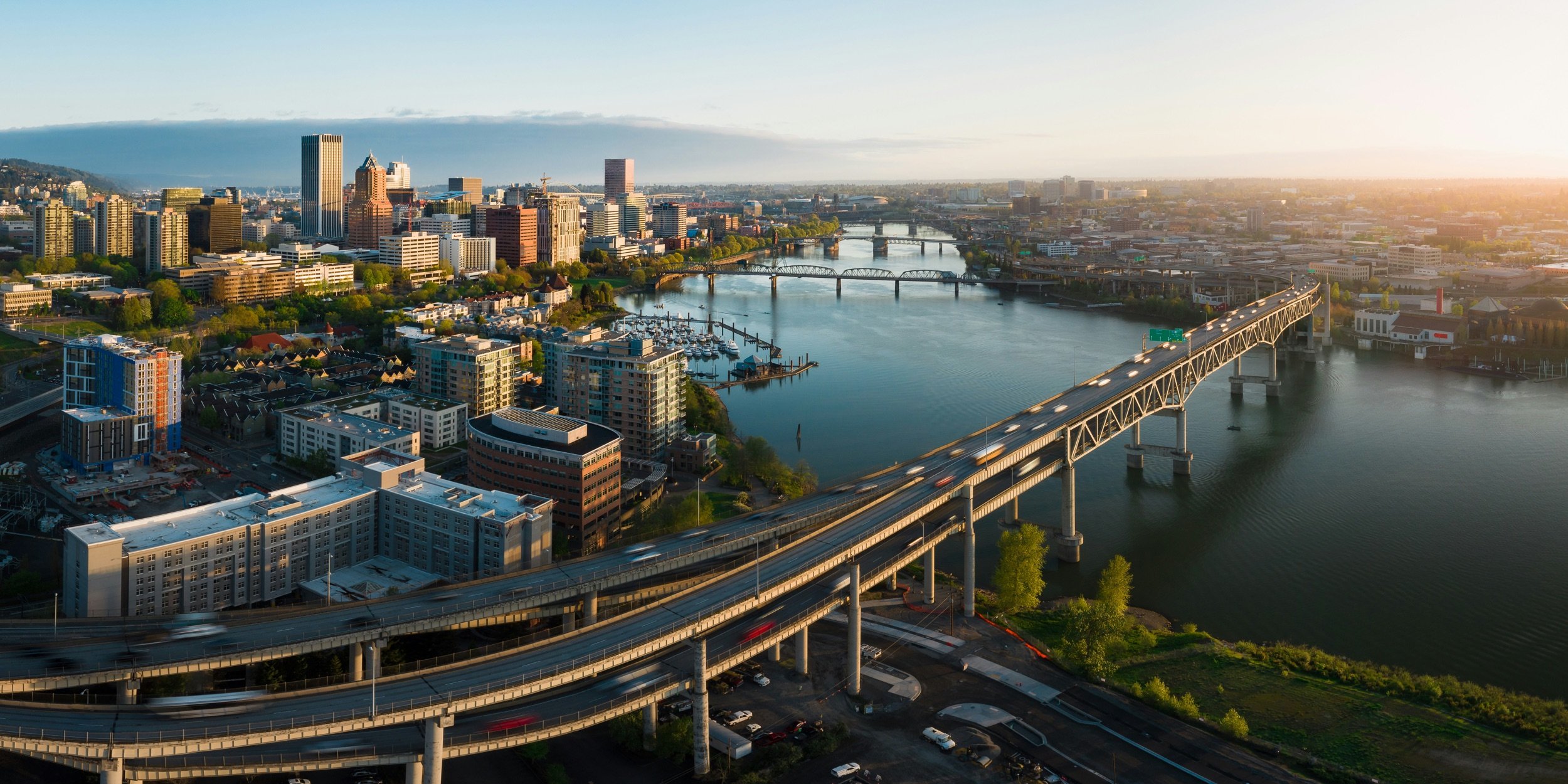
Portland is a city that keeps its old houses. The porches are deep enough to sit out a drizzle, the street trees are older than most of the people under them, and the neighborhoods still feel like neighborhoods: Irvington with its wide, leafy blocks, Ladd’s Addition with its diagonal streets, Sellwood and St. Johns with main streets of their own, and Northwest Portland running up to the edge of the woods. The Willamette River runs through the middle of it all and meets the Columbia just to the north.
Long before it was a city, this was the home of Chinookan-speaking peoples, the Multnomah, Clackamas and Tualatin among them, who lived in villages along the Willamette and the Columbia and on Sauvie Island, fishing the rivers and harvesting wapato in the wetlands. People have lived in the Portland Basin for thousands of years. Diseases that arrived with traders and settlers devastated the villages in the early nineteenth century, but the names are still written across the map: Multnomah, Clackamas, Tualatin.
The city itself began with a land claim and a coin. In 1843 Asa Lovejoy and William Overton claimed a stretch of the Willamette’s west bank known simply as The Clearing, and Overton soon sold his half to Francis Pettygrove. Lovejoy, from Massachusetts, wanted to call the town Boston. Pettygrove, from Maine, wanted Portland. In 1845 they flipped a coin, best two out of three, and Pettygrove won. That 1835 copper cent, the Portland Penny, is on display at the Oregon Historical Society. Portland was incorporated in 1851.
The city grew up as a river port, then announced itself to the world with the 1905 Lewis and Clark Centennial Exposition, the first world’s fair held in the western United States, laid out by the Olmsted firm above Guild’s Lake. More than two and a half million visits later, Portland had a building boom on its hands. The streetcar lines pushed east across the river, and the inner east side filled in, block by block, with Craftsman bungalows, foursquares and Colonial Revival houses. Ladd’s Addition, platted in 1891, filled with bungalows, Tudors and foursquares between about 1905 and 1930. Irvington, reached by streetcar in 1899, became one of the city’s great early twentieth-century neighborhoods and was listed on the National Register of Historic Places in 2010.
It’s also one of the great architecture towns of the West, and the reason I fell for it. In the 1930s a young John Yeon designed the Watzek House in the West Hills, a low wood house with long eaves to keep the rain off its glass and rooms aimed at Mount Hood. It helped define what came to be called Northwest Regional style and is now a National Historic Landmark. Pietro Belluschi designed the Portland Art Museum in the early 1930s, built a series of wood houses and churches that belong to the same regional tradition, and finished the Equitable Building downtown in 1948, one of the first glass-and-aluminum office towers in the country. Wood, glass, rain and views: Portland’s modernism grew straight out of its weather and its hills.
And then there’s Forest Park, more than 5,000 acres of forest inside the city limits, dedicated in 1948, with more than 80 miles of trails, including the 30-mile Wildwood Trail. You can leave a Northwest Portland Victorian on foot and be under the firs in minutes.
Just Portland is where I keep the record: the architects, the streets and the houses, the parks and the places, so that when you’re thinking about a move, you already know the story. Start with the neighborhoods, wander through Places, or keep the Portland 411 handy.
Wood, glass, rain and views: Portland’s modernism grew out of its weather and its hills.
The bigger map
840 miles: a love letter to California
California isn’t a state so much as a state of mind, and after 24 years of helping people find their place in it, I love it more now than the day I started. From the fog-soaked headlands of Mendocino to the palm-lined beaches near the Mexican border, across 840 miles of coastline and everything that unfolds inland, this is a place that rewards curiosity and invites reinvention. It’s where the redwoods meet the Pacific, where the desert blooms after winter rain, where snow-capped Sierra peaks look down on valleys of vineyards and orange groves. No single landscape defines it, and that’s exactly the point.
California has always been a place people come to become. The surfers and the screenwriters, the farmers and the founders, the artists and the architects, everyone who’s ever stood at the edge of this country and decided to stay. You can eat a Santa Barbara strawberry in the morning, hike through a Joshua Tree sunset that evening, and fall asleep to the sound of the ocean in Malibu. You can walk Ojai’s quiet streets at golden hour, lose an afternoon in a Healdsburg tasting room, or wander the Mission Revival courtyards of Santa Barbara and feel the whole long, layered history of the place. I’ve shown homes in nearly every one of these towns, and each one has taught me something new about what it means to live here.
Our cities are their own small countries. San Francisco’s fog and hills, Los Angeles’s sprawling creative engine, Santa Cruz’s easy coastal grace, Sacramento’s historic rhythm, and the countless small towns in between, Cambria, Cayucos, Carmel, Mendocino, Idyllwild, each with its own accent, its own pace, its own light. And always, always, that light. The California light is a thing unto itself, the kind that’s drawn painters and cinematographers here for a hundred years and never stopped giving.
This is why I named my company Coastline 840, for the 840 miles that hold all of it together. California is where I’m licensed and where I sell homes, from a mid-century in Studio City to a retreat in Ojai; my architectural homes practice is at debbiepisaro.com. Portland is the city up the coast I keep coming back to for its houses and its architects, which is why this guide exists.
If you’re moving between the two, from Portland down to California or the other way, I can help with the California side myself, and for Portland I’ll connect you with a licensed Oregon broker who knows the neighborhood.
Moving to Portland, or leaving it?
Moving to Portland, or leaving it? One call to Debbie gets you a licensed Oregon broker who knows the neighborhood.
Contact · debbie@coastline840.com · (310) 362-6429
Moving to Portland, or Leaving It?
One call to Debbie gets you a licensed Oregon broker who knows the neighborhood. Debbie Pisaro is a California real estate agent (DRE #01369110) and refers Portland buyers and sellers to licensed Oregon brokers.